Friday, November 22, 2013

Secretary of the Treasury Tim Geithner moves into Private Equity

Tim Geithner left the treasury with two goals, the first being to write his own account of the financial crisis and the second to make some of his own money. His book is done and due to be published next year, so that is goal one. Last Saturday Mr. Geithner announced he is joining Warburg Pincus so that would be goal two. Mr Geithner will be joining the ranks of other public officials such as David Petraeus KKR's Chair of the Global Institute and Kenneth Mehlman who became their Head of Global Public Affairs.

Mr. Geithner's wealthier friends have said that he, "needs to make some money". Spending most of his career in government finance, in the treasury he made around $200,000 a year plus $411,000 a year and a $436,686 separation payment from the Federal bank of new york. This may seem like a lot of money but compared to the corporate salaries of his friends in the private sector it is not much.

Warburg Pincus trusts that they will get more than just high level contacts and insider knowledge of the treasury from Geithner. They know that he has proved himself as investment savvy. While working at the treasury Geithner dealt with hundreds of billions of dollars in  investments for financial institutions to prop up the economy.

“The roots of Warburg Pincus go back 45 years and we are really much more a global growth-oriented entrepreneur-centric investor,” says Chip Kaye, co-chief executive. “We have been active in starting and building businesses in energy, technology and healthcare; and we were very early investors in China and India. I think that’s one of the things that most attracted Tim – a broader investing context.”

“He supervised the management of what was, for a time, the largest investment portfolio in the world,” says Mr Millstein. “And though the public will never give him credit for it, he did it very successfully.”

Tuesday, November 19, 2013

Dropbox worth 8 billion

Dropbox the cloud storage service is looking to raise an additional $250 million dollars with a valuation around $8 billion. This round of fundraising follows Pinterest's latest round, which raised $225 million with a value of $3.8 billion. There has also been lots of hype over Snapchat and their most recent turn down of offers.


Dropbox has already raised $257 million dollars over the last 5 years. Dropbox is looking to raise another $250 million in the next few weeks. Dropbox currently has 200 million private users and 4 million business users. Dropbox has yet to expend all of the money they raised in their last round of fundraising.

So why does Dropbox need a new infusion of capital. First off in the past they have mostly been spread by word of mouth, but as they grow and try to expand their entrepreneurial services they will need a sales team as well as new technology to support a higher level of quality and more services. Both of these things are expensive. Second they are already competing against big names like Google, Amazon and Microsoft for the same space.


Social Media Bubble

Social media companies have all been getting a lot of financial attention. Facebook's IPO was a big deal and Twitter followed suit last month. However the hype over these stocks has created what some are calling the next tech bubble to burst. These social media companies are massively overvalued.


LinkedIn is a great example, the stock price and market cap exceeds LinkedIn's value to such excess it is absurd. There is no traditional valuation that can support the market's opinion of these social media stocks. No one expects these bubbles until they actually do burst, there are some blogs and writers out there warning of these problems but the money is still flowing regardless.

The current valuation of Facebook is 122 times its earning and has a market cap of $122 billion. LinkedIn has a price to earnings ratio of 1000 and a market cap of $28 billion. Pandora the personalized digital music radio service has a market cap of $4.52 billion. The market seems to be following the same trend as in the dot com bubble, caring more about engagement and potential customers than actually making money. Twitter is a great example, their IPO was a great success which is surprising for a company that has never turned a profit.

There may still be a long runway left for the social media market. But, when the excitement finally does end I would expect these companies to crash by likely 80-90%.

“We are certainly in another bubble,” says Matthew Cowan, co-founder of the tech investment firm Bridgescale Partners. “And it’s being driven by social media and consumer-oriented applications.”

Snapchat turns down facebook offer


Snapchat has been getting a lot of attention lately, with offers from Facebook and rumored offers from Google.

Snapchat is a mobile service that allows you to send photos and videos that delete themselves after being seen. The offer which Snapchat turned down from Facebook was for $3 billion dollars. With a reported 400 million images and videos being send daily, the service has quite a large user base. Facebook currently reports around 350 million photos and videos being uploaded daily and Instagram has a reported 55 million.

It seems amazing that the company would turn down such a large offer for their services although they may have their sites set higher looking to follow the example of Twitter which IPO'ed to great success. Kids are not using "traditional" social media as much as they used to, and reports show less Facebook interaction with young adults than before. Snapchat on the other hand has an estimated 26 million users but more impressively 26% of all adults between the ages of 18 and 29 are using the service.

“A college dropout running a company with almost no assets, no revenue and a mountain of legal problems, (Evan) Spiegel is betting Snapchat can transcend the stigma of the ‘next big thing’ and become an industry unto its own….either one of the most brilliant entrepreneurs ever, or a delusional fool.”, which delved into what it called the “sext message” origins of the service.

Similar to many social media sites and services, Snapchat is not profitable and has no clear business model. This however has not stopped companies like Facebook and Google who are more interested in engagement than profit, from making offers.

Friday, November 8, 2013

Lazard has announced principal offering

Lazard has announced that one of its subsidiaries Lazard Group LLC, also known simply as the Lazard Group, is commencing principal offer of senior notes due in 2020. The offer will be worth $500 million and the notes will be issued by Lazard Group. They will be offered pursuant to an effective shelf registration statement filed with the Securities and Exchange Commission, they will be senior unsecured obligations of Lazard Group.

In addition to the notes offering the Lazard is starting a cash tender offer. This offer will be for all its outstanding 7.125% of senior notes due May 15th, 2015. With these existing notes, Lazard Group expects to exercise its right to redeem all existing notes not purchased in the tender off at a make-whole price. The group intends to use the profits from the notes offering along with cash to purchase or redeem all of its outstanding existing 2015 notes and to pay fees and expenses related.

There are a number of groups acting as dealer managers for the tender offer, they include: Citigroup Global Markets Inc., Goldman, Sachs & Co., and Lazard Frères & Co. LLC.


Thursday, November 7, 2013

Washington State tears off GMO label bill

Washington state experienced an expensive fight over the labeling of genetically modified foods or GMOs. The bill in question would have mandated that all foods containing GMOs are labeled clearly for consumers, including cereals, soft drinks chips and many other items. The bill was ultimately voted down by Washington voters by a 10 point margin.


The for labeling campaign calling for greater consumer transparency through labels of all products containing GMOs. The against labeling side claimed that labeling GMO foods would create an increased cost to consumers.

The opposing side had a lot of large financial backers including the Grocery Manufacturers Association which represents big food corporations such as Campbell Foods, General Mills, Hillshire Brands, and PepsiCo. Together they raised contributed $1 million dollars to oppose the bill. Other donations against the bill came from big agricultural companies such as DuPont, Monsanto and Bayer CropScience. Their contributions totaled around $11 million.

So now that the bill didn't pass and GMOs are not labeled we should ask ourselves, how much of our food is GMO and does this make a difference?

If we look at the GMOs crops grown today, around 95% of U.S. commodity crops are GMO. This includes 94$ of sugar beets, 90% of soybeans, and 88% of cotton and feed corn. Papaya are an interesting case that demonstrates the benefits of GMOs. In the 1980s basically all papaya was wiped out of Hawaii due to a ringspot virus. Today papaya's grow again on the islands due to virus resistant GMO crops. In the actual stores GMO foods include basically any processed foods with sugar. For the most part non-processed foods are not GMO, for example tomatoes, potatoes, wheat and rice are not GMO in the U.S.

Now there is a lot of talk about GMO foods being unhealthy. This for all intents and purposes is not true. If we look at sugar as a general example, by the time it is processed and put into your food the sugar has no chemical difference between non-GMO sugar.

There are also claims that crops that are genetically modified with other animals DNA are some how bad for us. The idea that DNA is somehow owned by one animal or another is also absurd. DNA and RNA create the language or code that define life. Essentially all living things have this code and share similar parts of it. Taking code from a fish to create corn with protein may sound weird but it is just a length of code. Humans may share 99% of our DNA with apes but we also share 30% of our DNA with a potatoes.

I think GMOs are a amazing step forward for science, being able to make crops resist viruses and grow more effectively with less water has huge agricultural advantages.


Tesla runs out of juice again

Tesla cars are so fricken cool!!!


Prices for the cult stock Tesla tanked again this week. Tesla this week reported a better than expected
Q3 earnings report, so why did the stock tank?

Essentially Tesla has become so hyped that anything better than perfect will cause turmoil for this stock. So much performance is expected form the company that to not perform to that expectation will effect the stock price.

In this quarter Tesla outperformed their own goals of selling 5000 new model S cars, however investors were expecting no less than 5850 cars. Tesla delivered around 5500 new models. Now the problem is not that there is not demand for the car. Tesla actually can not keep up with their demand, and this is not their fault. Currently they are having shortage of batteries which is slowing down sales. Even though this set back is not Tesla's fault it still had a negative affect on stock price because of the unreasonable expectation set for the company.

The result of this set back send stocks plunging yesterday dropping  from $176 to $142 where it sits today. The fall was so rapid yesterday it triggered the exchanges short sale circuit breaker (this does not happen often). This breaker temporarily stops sales of borrowed shares.

Analysts estimate the stocks actual value is somewhere around 141$. However with the amount of hype and attention the company is getting, this stock will likely still see a lot of dynamic change. Rising on minor achievements and crashing on small setbacks.

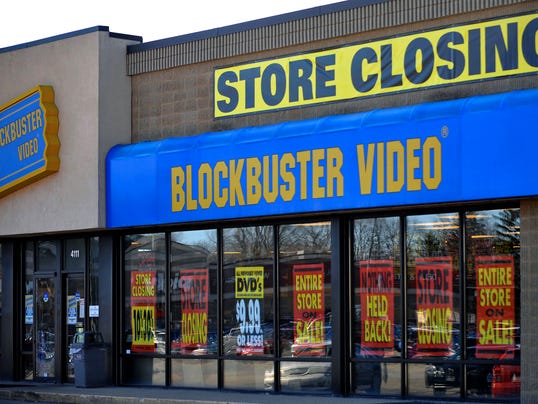
Blockbuster is shutting its doors.

Blockbuster the once popular video rental chain is putting the last nail in their coffin. The company has seen a steady decline in business over the last 5 years and has not been able to compete with other video services such as RedBox or Netflix. Blockbuster's mail services and streaming services simply were not able to compete.

Blockbuster shuts down
Blockbuster announced that they will be stopping all retail and mail order services next January. Blockbuster was bough by Dick networks in 2010 after going bankrupt. This purchase included roughly 300 locations both domestic and internationally. This shutdown will result in the termination of around 3000 jobs.

The Blockbuster streaming services will continue moving forward. Dish says the Blockbuster franchise will stay open and that they will retain all licensing agreements with Blockbuster. For Dish users this included 15 movie channels with thousands of movies.

With old relics like Blockbuster finally disappearing it makes me wonder what will happen the the video world next. How will we see Netflix and Amazon grow in the next 10 years.


Tuesday, October 29, 2013

KKR to invest $100 million in wireless infrastructure

KKR is making its 11th infrastructure investment. This time they are focussing on wireless infrastructure in rural America. KKR will be a minority investor in its three different communication companies.

1. PEG Bandwidth is a company that builds and operates backhaul networks. Their focus is on connecting wireless communication towers to the data and fiber backbone networks on the ground.
2. AP Wireless buys cell sites both on the ground and on rooftops (domestic and international.)
3. AP Towers develop wireless communication towers and purchase already existing towers.

With the explosion of smart devices there has been a dramatic increase in demand for data. This demand is driving investments into wireless infrastructure. The current infrastructural grid is drastically outdated and in a large part of the country still consists of copper cable, which is unable to handle the burden of big data.

Raj Agrawal, KKR's Head of North American Infrastructure said, "The need for wireless infrastructure will continue to be driven by increases in wireless data usage that is overwhelming existing network capacity... We are excited about the opportunity to partner with Associated Partners to grow this premier set of businesses with critical telecom infrastructure assets."

KKR appears to be betting on factions of the economy that are driven by technical revolutions. In the last year they have also invested into natural gas. With the development of shale natural gas, the amount of natural gas available has skyrocketed.

"As the shale revolution is driving the growth of natural gas pipelines to transport molecules, the advent of the smart phone is driving a similar wireless explosion to transmit electrons. Wireless communication networks are an essential component of the nation's infrastructure," said Scott Bruce, Managing Director of Associated Partners, L.P. "We are excited to have KKR partner with us as we expand our businesses."

About KKR

Founded in 1976 KKR is  led by Henry R. Kravis and George Roberts. KKR is a leading investment firm with $90.2 billion under management as of September 30, 2013. With offices around the world, and notable global voices such as David Petraeus,  KKR manages assets through a variety of investment funds and accounts covering multiple asset classes. KKR seeks to create value by bringing operational expertise to its portfolio companies and through active oversight and monitoring of its investments.

$1.3 billion net profit for Ford in Q3

Ford reported $1.3 billion in net profits for quarter 3 of this year. This profit was driven by continued strong sales in North America and less losses in Europe. The net income is down from last year by $359 million but is still a good showing for the American automobile maker.

Automotive sales for ford rose 12% this year to $33.9 billion. Much of this progress is attributed to CEO Alan Mulally. Mr. Mulally has turned Ford's North American operations around, broadening their lineup and adding more competitive cars. He also plans to develop identical cars all around the world. So far Ford has seen great success in China with their focus which has become the top selling car name. Shares of Ford have risen 35% this year.


shares have risen 35% this year. compared to the S&P at 22% rise this year. results show continued progress in Mulally's repair of the company since he left boeing co. in 2006.

“The heavy lifting has been done in North America, they’re working through their issues in Europe, and the China growth strategy is in place,” said Michael Razewski, a New York-based principal at Douglas C. Lane & Associates, which oversees $3.4 billion including Ford shares. “This isn’t necessarily a business that needs to be transformed anymore.”

The company expects profit margins to be higher than last year.


Twitter, a great IPO?

There is a lot of buzz around the Twitter IPO. Twitter a company that started as a small microblogging site has developed into a giant microblogging site with millions of users and an enormous reach. Twitter has become one of the most influential websites today.

Twitter announced last Tuesday that they have obtained a $1 billion line of credit from independent American banks, these include Goldman Sachs, Morgan Stanley, JP Morgan, Bank of America, Merrill Lynch and Deutsche Bank.

Twitter has been very closely watched, especially since Facebook went public last year creating a hype around trading social media companies. Although Twitter has grown dramatically in the last couple years to a large size it may not be prepared to be public. First off Twitter is not a profitable company and has lost 2.8 million in the first six months of this year and 6.5 million in revenue.

In order to satisfy investors Twitter needs to answer some important questions

1. How fast will revenue grow and from what sources?
2. When will this turn into a profit?
3. How much can the company profits increase before reaching a plateau?
4. What investments does Twitter plan to make?
5. What is the rate of return expected on investments?

Twitter is currently losing money fast and this loss is accelerating, losses from the 3rd quarter were almost as big as the first half of year. I expect when Twitter finally does go public later this year that the stock will see a large hype before dropping and if the company does figure out how to monazite they the value will skyrocket. We saw a similar performance from Facebook earlier this year.

Friday, October 25, 2013

Carl Icahn turns to Apple

The American businessman and investor Carl Icahn is turning his attention on Apple. Mr. Icahn recently cashed out on his Netflix Investment with a 457% profit. He has now increased his stake in apple to 4.7 million shares. Although this is a daunting number for some it is only half of 1% of Apples outstanding stock.

In a recent letter from Mr. Icahn to Apple's CEO Timothy Cook, he called for immediate tender of stocks. Icahn is pushing the company to repurchase 150 billion in stock at 525 a share. This tender offer would be funded by a combination of new debt and available cash. In addition he want Apple to raise its dividends to share holders.

Icahn claims that this tender would increase earnings per share to 33% through a reduction of share count. He also claims that the result would be a rise in price per share to $1250 in the next three years. Mr Icahn vowed that he would not participate in the tender or sell his shares.


In a statement  he said, “In my opinion, any further delay in executing the buyback we hereby propose will reflect this lack of expertise on the board,” he writes. “My firm’s success and my expertise as an investor would be difficult for anyone to argue.” Although Mr. Icahn has a large amount of shares, he does not have a considerable amount of control of the company. He has however gained considerable influence due to his considerable winning streak.

Mr. Icahn is one of a many "activist investors" who want to give more capital to shareholders. Apple stock is down 25% from its 705$ peak around this time last year. Apple is expected to report their quarterly earning on Monday October 28th. The letter from Icahn to Cook is published on his activist website www.shareholderssquaretable.com

To read more


Tuesday, October 15, 2013

Lazard sends George Bilicic to Chicago to reinvigorate the office.

Lazard, Lazard CEO, Kenneth Jacobs, Ken Jacobs, George Bilicic
George Bilicic new lead Lazard Ltd. investment banker in Chicago
Two senior bankers on the deal-making side of Lazard Ltd.'s advisory business have exited the Chicago office earlier this year. In response Lazard has send George Bilicic Jr. to take control and reinvigorate the company office in Chicago.

This is Mr. Bilicic second stint working with the Chicago office. He first started supervising the office remotely in 2006.

When asked about his previous experience Mr. Bilicic said, "The chief lesson learned from that was that you couldn't be a suitcase banker and be successful with companies in the Midwest." In this round of work Mr. Bilicic is moving to the windy city with his family. He has never lived in Chicago before and plans to expand business by becoming active in city business as well as the civic scene, joining organization boards in the city and having his bankers to the same.
Lazard, Lazard CEO, Kenneth Jacobs, Ken Jacobs.
Kenneth Jacobs, Lazard CEO

While Bilicic has not stated any specific boards or charities he plans to participate in his direct superior, Lazard CEO Kenneth Jacobs is a member of the board of trustees for the University of Chicago.

Lazard is a midsize international financial advisory and faces competition from Larger entities such as Goldman Sachs Group Inc. The company has about 2,400 employees world wide and aims to cut around 250 this year while expanding growth.  Lazard earning nearly doubled in the second quarter with $59.9 million. This is in part due to its jump in deals in its consumer, health care services and technology areas.


Facebook acquires Onavo


Facebook Inc the social networking company recently acquired Israeli analytics app maker Onavo. Facebook supposedly bought Onovo for a project aimed at making the Internet available to billions of people around the world who are not currently online, Onavo's data-saving capabilities have promise for this project.

Onovo's mobile app helps people cut their phone costs, their app claims to be able to use data more efficiently and allow users to get up to five time more usage out of a data plan. Their data saving features are likely to help Facebook provide internet by reducing the amount of data downloads required to run its mobile internet applications.

"We expect Onavo's data compression technology to play a central role in our mission to connect more people to the internet, and their analytic tools will help us provide better, more efficient mobile product," said a Facebook spokeswoman.

Facebook supposedly paid between $150 million and $200 million in the deal. This is the largest deal for the social networking site since their purchase of Instragram last year.

Part of the deal will include Onavo's Istraeli offices. Facebook will transfer some of its employees, and run a research and development facility in Israel.

What will happen if the U.S. defaults.


October 17th, Thursday is the debt ceiling deadline for congress. With the government still shut down there is some argument about what will actually happen if or when congress does not reach a consensus.

A couple things will happen when the U.S. doesn't make its deadline on Thursday. Financial shockwaves will run through banks and blow a hole in the economy comparable to the 2008 financial crisis. This will result in a rise in unemployment. The loss of confidence in the U.S. treasury will affect the value of the dollar. Devaluation of our currency will affect many things including interest rates, and mortgage rates.

The markets will go down and investments will dry up. In 2008 the major stock indexes took a 37% hit. After 2008 the U.S. saw its worst recession since the Great depression, it is staggering to think that law makers are willing to create a similar crisis. To prevent a further downward spiral the U.S. treasury pumped 3 trillion dollars into the financial system and provided 300 billion in fresh capital to the nations banks. The 2008 crisis was caused by a private financial institution no where near the size of the U.S. government, the scale of the crisis if the U.S. defaults would be much larger. 

Stocks on the rise during the shutdown?

GOP, shutdown. Decline
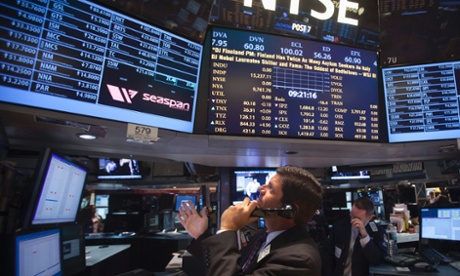
A trader looking up at a screen on the floor of the New York Stock Exchange. 

The government is on day 15 of the shutdown. All across America federal employees are furloughed and a large number of government institutions are barely running. With so much of the country out of commission and the default deadline looming over congress, why does it appear that the financial sector has not taken notice.

I think the answer here is that no one on wall street truly believes that we will default. The general consensus is that there is no way our politicians would be so selfish and crash the economy in order to win a pissing contest.

The financial sector's confidence is reflected in last weeks markets. Stocks closed high on Friday under hopes of discussion and a deal. The Dow Jones rose 64 points or 0.4% to 15301 after being down 100 points. The S&P rose 7 points also 0.4% to 1710 and the NASDAQ gained 23 points a 0.6% gain to 3815.

Tuesday, October 8, 2013

If we ever get over this political crisis, is there growth ahead?

So far the market has not really been phased by the government shutdown. We have seen a small downturn this week but no large change. However if the U.S. does does not come to a consensus over the Affordable HealthCare Act and we don't raise the Debt Ceiling it could have catastrophic consequences on the economy. Most investors seem to be complacent saying that the shutdown/debt ceiling is not a reason to sell stocks. However, if the U.S. does reach what many think to be a 0% chance scenario where we are unable to pay the interest on our loans it is predicted that the S&P 500 would crash to 850, about a 50% drop.

However if we do make it past this Political fiasco the economy may still have juice left to climb. I have written a few times before about KKR, as experts in the market they often provide useful insights. Alex Nevab KKR's co-head of Americas private equity said, "We actually see the economy recovering and has further to go through 2016 or 2017." KKR believes that if we do get past this debt ceiling crisis that the market was not at a low point or a high point and is showing a good environment for growth. Other notable leaders in KKR include former RNC chairman Kenneth Mehlman and General David Petraeus.

High Dividend Stocks for 2014

In this piece I just want to outline some high dividend stocks with upsides for 2014. Most of the research I'm presenting here was done by Meena Krishnamsetty a Marketwatch corespondent, see the link below.

There are only 47 stock in the S&P 500 that pay dividends higher than 4%. Here is a list of some of the best investments on this list.

Merck: 4.1% dividend and shares have risen more than 9% in 12 months.
Intel: Shares yield 4.2%,  one of few in its sector with such high yields.
Verizon: 4.6%, ranked third among many as a mega dividend favorite.
Conoco Phillips: Only Oil and Gas industry to pay out a dividend of at leas 4%.
Lockheed Martin and Altria Group: both pay out yields greater than 5%

http://www.marketwatch.com/story/6-high-dividend-stocks-with-upside-potential-2013-02-14

Groupon Saw Growth in 2013.

Groupon if you have not heard of it is a deal-of-the-day website that features discounted prices for local or even national companies. The company was first launched in November of 2008, and was first marketed in Chicago, it later spread to Boston, New York and Toronto. Groupon grew into over 150 markets by 2010 and has been growing since. Today Groupon is up 368% from its 52 week low of $2.60, they have reported positive earnings.

Wednesday, October 2, 2013

KKR china


Supported by their global institute run by David Petraeus and Ken Mehlman KKR has been expanding into Asian markets. In China specifically they have recently agreed to buy a 10% stake in Qingdao Haier Co Ltd. a large appliance maker. This stake in QHC is KKR's biggest investment in China to date and is their third asian deal with in a week. The investment is speculated to be around $550 million, a small portion of their $6 billion Asian investment fund.

KKR expects to see a large growth in the appliance market in China, at lease 1/5th in the next two years and they are not the only ones. Two months ago Whirlpool Corp, the worlds larges appliance maker also invested a similar sum into China.

Smart Cars are everywhere!


Smart cars have been gaining in popularity but your probably wondering how do I invest in Smart automobile. Well Smart Automobile is a branch of Daimler AG. Daimler AG is a German company and a multinational corporation. They are headquartered in Stuttgard Germany. In addition to Smart their other brands include Mercedes-Benz, Mercedes-AMG, Freightliner, Western Star, Thomas Built Buses, Setra, BharatBenz, Mitsubishi Fuso. They also own shares in Denza, KAMAZ and Renault-Nissan Alliance. 

Daimler is the 13th largest car manufacturer in the world and is looking to expand into China. However they are not keeping up with companies such as Audi or BMW, seeing 18% and 15% growth respectively compared to Daimler AG which was flat. With respect to their other brands, china is an expanding market. China is expected to have an increased demand for luxury cars in the years to come. It is not apparent yet weather Daimler will be able to fill the Chinese market but their stock is up this year sitting at $78.16 today up from a low this year of $44.90.

Yelp


Not all .com companies have seen the same growth this year. However Yelp is one of the good ones. Starting the year off below $20 a share they have seen steady growth and today are sitting close to 70.16. Yelp is an online company that aides in local search. Their main source of revenue is from advertising on their website. Their ranking system of businesses as well as the use of comments and ratings has been under some controversy.


Thursday, September 26, 2013

Fiat to buy the rest of Chrysler

Fiat is again moving in on Chrysler. In 2009 they took over a large percentage of the company and are now trying to take over the remaining 41.5%. This remainder is currently held by UAW health. The two companies have been in conversation over the sale but have been unable to agree on a price, they have a discrepancy of around $2 million.

Lazard, Kenneth Jacobs, Ken Jacobs, Ron Bloom

The recently hired Lazard Ldt (NYSE: LAZ) vice chairman Ron Bloom to help with the buyout. Other notable leadership at Lazard include chairman and CEO Kenneth Jacobs. Ron Bloom is also currently representing the retirees in their case against Detroit's filing for bankruptcy.

Investing in Solar

With all this environmentalism in the air, many investors are going after alternative energy stocks. Wind power saw a lot of action over the last year, with wind farms popping up all over the country. Solar has not seen the same sort of investment but maybe that will start soon.

One company to watch is Solar City (NASDAQ: SCTY). They are branding themselves as America's #1 full service provider and have been a pioneer for affordable clean energy. They run on a lease system with free panel installation as well as insurance and monitoring. The company claims that they can bring your cost of energy below the cost of utility companies.

As an investment they certainly have great leadership, their chairman in Elon Musk, you might recognize his name from Tesla or perhaps SpaceX. The company is still working on becoming profitable but has seen a lot of growth this year. Their stock is up 110% for the year. Definitely a stock to watch.

Pandora Jump Ship!

Pandora has seen amazing growth in the last year starting at a low of $7.18 in november and rising to over $26.99 last week. Pandora internet has become a part of many of our lives. It is a great way to find new music and I know that my office and many other listen to Pandora during the day. They have seen subscriptions increase 38% since last year.

Now if you invested in Pandora a year ago, you probably made out really well with around a 176% return on investments. However with the launch of Apple Radio Pandora has already seen a big hit to their stock, 10%. With a more streamline way to listen to the radio and buy music, Apple is a huge threat to Pandora. In addition Apple radio is 30% cheaper for subscription. The initial launch of Apple radio saw 11 million unique users. This is definitely formidable for Pandora, if you already have stock and have not sold it yet, jump ship now, sell!

Wednesday, September 25, 2013

Investments in Natural Gas


As I'm sure many of you have noticed Natural Gas has gone through what many have called a revolution. The techniques involved with fracking have caused a full on shale boom. The boom of the fracking industry brought so much gas to the market that it overwhelmed the market capacity and send prices crashing. Drillers have so much gas right now that they are burning off millions of dollars in gas with no where in the market to take it. Many fleets are even making the switch from burning diesel or gasoline fuels in favor of natural gas. In some cases this has resulted in fuel cost savings of up to 40%. So where are the investment opportunities surrounding natural gas?

Clean Energy Fuels 
This company is building a network of fueling stations to bring gas to market and to new customers. This company is not making money yet, but it is very new and has a good head start investing in the infrastructure to support the 30% of new transit vehicles powered by natural gas.

Mega Cap Energy Players
Companies like Chevron, Royal Dutch Shell, and ExxonMobil that already have natural gas projects should also do well. Given the volatility of the gas market these more diverse companies will remain stable. The gas market is definitely on the rise but once the market becomes more global and shipments start flowing to say Asia portfolios should definitely see a bump. Although I wouldn't expect a large bump until 2015.

If you would like more information on opportunities in shale Gas. KKR's Global Institute chaired by General David Petraeus and run in tandem with Ken Mehlman released a detailed report on Historic Opportunities from the Shale Gas Revolution

Will V.F. Corp continue to climb?


V.F. Corporation (NYSE: VFC) is a global apparel company based in the United States. V.F. designs and manufactures a variety of apparel and footwear. Some of V.F.'s brand names include: Wrangler, Lee Jeans, JanSport, The North Face, SmartWool, Timberland, and Nautica. The company hit a 52-week high of $204.94 on Friday, September 20, 2013. The stock of the company gained momentum after announcing their initiatives and strategies to enhance its performance amid a soft economic scenario.

Recently the company announced the opening of three global innovation centers to concentrate on developing revolutionary product innovation in technical apparel, footwear and jeans.  The stocks also reflect the positive earning momentum of the company. In the past 10 quarters V.F. has outperformed expert expectations by an average 7.5%. Based on its current growth and a good focus on further brand development I think this company is well poised for long term growth.

Why are so many people interested in Seattle Genetics?


Seattle Genetics (NASDAQ: SGEN) is a biotechnology company that has caught the attention of many hedge fund managers. This Seattle based biotechnology company is focused on the development and commercialization of monoclonal antibody-based therapies for cancer. They currently have one drug on the market, Adcetris or brentuximab vedotin. This drug is approved in the U.S. by the FDA for treatment of Hodgkin lymphoma and is an antibody-drug conjugate or ADC.

So what makes Seattle Genetics a promising investment? The company currently has one drug on the market. Adcetris has performed very well since its release and has won 70% of the market for its approved uses. The drug has generated $70 million in revenue in the first half of the year. In addition Adcetris serves as a showpiece for the companies antibody-drug-conjugates, these complex molecules deliver payloads directly to cancerous cells without the collateral damage associated with traditional chemotherapy. Many major drug companies have made deals or are trying to make deals to gain access to Seattle Genetics's ADC portfolio.

This being said Seattle Genetics has a lot of potential, so far this year their shares are up more than 65%. On the downside for a company valued at nearly $5 billion, Seattle Gen still not turning a profit. I like their potential, they have good science and good collaborations, and if Adcetris is really successful that could be really good for the company. However like many life science companies Seattle Gen is still struggling to be profitable. If you do jump on Seattle Gen, I would recommend balancing your portfolio with some other more stable long term investments, but never the less this is still a company to watch.

Wednesday, September 18, 2013

KKR to Invest in Mainland China Property Market


Kohlber Kravis Roberts (NYSE: KKR) is one of the worlds largest private equity firms. It is an American multinational firm specializing in leveraged buyouts. The firm has completed over $400 billion of private equity transactions and was a pioneer in the leveraged buyout industry. Today they are still led by two of their founders George R. Roberts and Henry Kravis. Other notable KKR leaders include former chair of the Republican National Committee Kenneth Mehlman and former U.S. Commanding General David Petraeus.

Recently KKR has been looking into real estate investments throughout mainland China. This is an interesting choice of investments for the firm given China's concerns that its property market, although hot may be turning into a bubble. KKR this year launched its second fund dedicated exclusively to Asia. The most recent of these is a $6 billion private equity fund. In China specifically KKR is taking local stance with respect to their investments. The majority of their investments will be minorities. Joe Bae a managing partner says that KKR will focus on areas outlined by the government as needing improvement. He stated,

“Real estate in China is by nature a very local business, so I think you really need to have very targeted bets: in which city, what [type] of real estate – residential, commercial or retail.”
Kravis also stressed the mentality of KKR with respect to their investments. He stated that he does not want people to think of KKR as a "capital provider" but rather a "solution provider." He sees KKR's role as more than just a Capital Provider. In addition to their investments in China, Kravis said that Japanese firms which are known for their bureaucracy have become more open to foreign investment ideas.

JP Morgan's $800 Million Whale Settlement


JP morgan is paying $800 million dollars to the SEC and other agencies to put to rest its "London Whale" trading fiasco. The "London Whale" gets its name from JP Morgan Chase trader Bruno Iksil, (nicknamed the London Whale). Iksil took a large gamble on an obscure corner of the market and witnessed a spectacular loss. He incurred $6.2 billion in losses and allegedly mismarked some of the trades to cover up their magnitude. His boss is also being sued by the SEC for assisting in the cover up. JP Morgan has been the subject of an investigation by the U.S. government since the fiasco.

JP Morgan Chase is expected to pay $800 million in penalties and admit wrongdoing as part of a board regulatory settlement over the matter. An acknowledgment of wrongdoing by the company would be a high-profile win for the SEC. In addition to this investigation JP Morgan is also facing potential enforcement action from the Commodity Futures Trading Commission for allegedly placing misleading values on its derivatives positions behind the London trades. In spite of all of this the stock price (NYSE: JPM) has returned to pre-scandal levels.

An Introduction to Asset Management

Asset management refers to any system or company that monitors or maintains things of value for another entity or group. This could be referring to tangible assets such as property or perhaps intangible assets such as intellectual property. There are many asset management firms in the US and Canada as well as all around the world. This blog will look at what these firms are doing how this effects the companies they are managing as well as its effect on the market. We will also look at the leadership of these firms and what they do for their companies and communities.