Friday, November 22, 2013

Secretary of the Treasury Tim Geithner moves into Private Equity

Tim Geithner left the treasury with two goals, the first being to write his own account of the financial crisis and the second to make some of his own money. His book is done and due to be published next year, so that is goal one. Last Saturday Mr. Geithner announced he is joining Warburg Pincus so that would be goal two. Mr Geithner will be joining the ranks of other public officials such as David Petraeus KKR's Chair of the Global Institute and Kenneth Mehlman who became their Head of Global Public Affairs.

Mr. Geithner's wealthier friends have said that he, "needs to make some money". Spending most of his career in government finance, in the treasury he made around $200,000 a year plus $411,000 a year and a $436,686 separation payment from the Federal bank of new york. This may seem like a lot of money but compared to the corporate salaries of his friends in the private sector it is not much.

Warburg Pincus trusts that they will get more than just high level contacts and insider knowledge of the treasury from Geithner. They know that he has proved himself as investment savvy. While working at the treasury Geithner dealt with hundreds of billions of dollars in  investments for financial institutions to prop up the economy.

“The roots of Warburg Pincus go back 45 years and we are really much more a global growth-oriented entrepreneur-centric investor,” says Chip Kaye, co-chief executive. “We have been active in starting and building businesses in energy, technology and healthcare; and we were very early investors in China and India. I think that’s one of the things that most attracted Tim – a broader investing context.”

“He supervised the management of what was, for a time, the largest investment portfolio in the world,” says Mr Millstein. “And though the public will never give him credit for it, he did it very successfully.”

Tuesday, November 19, 2013

Dropbox worth 8 billion

Dropbox the cloud storage service is looking to raise an additional $250 million dollars with a valuation around $8 billion. This round of fundraising follows Pinterest's latest round, which raised $225 million with a value of $3.8 billion. There has also been lots of hype over Snapchat and their most recent turn down of offers.


Dropbox has already raised $257 million dollars over the last 5 years. Dropbox is looking to raise another $250 million in the next few weeks. Dropbox currently has 200 million private users and 4 million business users. Dropbox has yet to expend all of the money they raised in their last round of fundraising.

So why does Dropbox need a new infusion of capital. First off in the past they have mostly been spread by word of mouth, but as they grow and try to expand their entrepreneurial services they will need a sales team as well as new technology to support a higher level of quality and more services. Both of these things are expensive. Second they are already competing against big names like Google, Amazon and Microsoft for the same space.


Social Media Bubble

Social media companies have all been getting a lot of financial attention. Facebook's IPO was a big deal and Twitter followed suit last month. However the hype over these stocks has created what some are calling the next tech bubble to burst. These social media companies are massively overvalued.


LinkedIn is a great example, the stock price and market cap exceeds LinkedIn's value to such excess it is absurd. There is no traditional valuation that can support the market's opinion of these social media stocks. No one expects these bubbles until they actually do burst, there are some blogs and writers out there warning of these problems but the money is still flowing regardless.

The current valuation of Facebook is 122 times its earning and has a market cap of $122 billion. LinkedIn has a price to earnings ratio of 1000 and a market cap of $28 billion. Pandora the personalized digital music radio service has a market cap of $4.52 billion. The market seems to be following the same trend as in the dot com bubble, caring more about engagement and potential customers than actually making money. Twitter is a great example, their IPO was a great success which is surprising for a company that has never turned a profit.

There may still be a long runway left for the social media market. But, when the excitement finally does end I would expect these companies to crash by likely 80-90%.

“We are certainly in another bubble,” says Matthew Cowan, co-founder of the tech investment firm Bridgescale Partners. “And it’s being driven by social media and consumer-oriented applications.”

Snapchat turns down facebook offer


Snapchat has been getting a lot of attention lately, with offers from Facebook and rumored offers from Google.

Snapchat is a mobile service that allows you to send photos and videos that delete themselves after being seen. The offer which Snapchat turned down from Facebook was for $3 billion dollars. With a reported 400 million images and videos being send daily, the service has quite a large user base. Facebook currently reports around 350 million photos and videos being uploaded daily and Instagram has a reported 55 million.

It seems amazing that the company would turn down such a large offer for their services although they may have their sites set higher looking to follow the example of Twitter which IPO'ed to great success. Kids are not using "traditional" social media as much as they used to, and reports show less Facebook interaction with young adults than before. Snapchat on the other hand has an estimated 26 million users but more impressively 26% of all adults between the ages of 18 and 29 are using the service.

“A college dropout running a company with almost no assets, no revenue and a mountain of legal problems, (Evan) Spiegel is betting Snapchat can transcend the stigma of the ‘next big thing’ and become an industry unto its own….either one of the most brilliant entrepreneurs ever, or a delusional fool.”, which delved into what it called the “sext message” origins of the service.

Similar to many social media sites and services, Snapchat is not profitable and has no clear business model. This however has not stopped companies like Facebook and Google who are more interested in engagement than profit, from making offers.

Friday, November 8, 2013

Lazard has announced principal offering

Lazard has announced that one of its subsidiaries Lazard Group LLC, also known simply as the Lazard Group, is commencing principal offer of senior notes due in 2020. The offer will be worth $500 million and the notes will be issued by Lazard Group. They will be offered pursuant to an effective shelf registration statement filed with the Securities and Exchange Commission, they will be senior unsecured obligations of Lazard Group.

In addition to the notes offering the Lazard is starting a cash tender offer. This offer will be for all its outstanding 7.125% of senior notes due May 15th, 2015. With these existing notes, Lazard Group expects to exercise its right to redeem all existing notes not purchased in the tender off at a make-whole price. The group intends to use the profits from the notes offering along with cash to purchase or redeem all of its outstanding existing 2015 notes and to pay fees and expenses related.

There are a number of groups acting as dealer managers for the tender offer, they include: Citigroup Global Markets Inc., Goldman, Sachs & Co., and Lazard Frères & Co. LLC.


Thursday, November 7, 2013

Washington State tears off GMO label bill

Washington state experienced an expensive fight over the labeling of genetically modified foods or GMOs. The bill in question would have mandated that all foods containing GMOs are labeled clearly for consumers, including cereals, soft drinks chips and many other items. The bill was ultimately voted down by Washington voters by a 10 point margin.


The for labeling campaign calling for greater consumer transparency through labels of all products containing GMOs. The against labeling side claimed that labeling GMO foods would create an increased cost to consumers.

The opposing side had a lot of large financial backers including the Grocery Manufacturers Association which represents big food corporations such as Campbell Foods, General Mills, Hillshire Brands, and PepsiCo. Together they raised contributed $1 million dollars to oppose the bill. Other donations against the bill came from big agricultural companies such as DuPont, Monsanto and Bayer CropScience. Their contributions totaled around $11 million.

So now that the bill didn't pass and GMOs are not labeled we should ask ourselves, how much of our food is GMO and does this make a difference?

If we look at the GMOs crops grown today, around 95% of U.S. commodity crops are GMO. This includes 94$ of sugar beets, 90% of soybeans, and 88% of cotton and feed corn. Papaya are an interesting case that demonstrates the benefits of GMOs. In the 1980s basically all papaya was wiped out of Hawaii due to a ringspot virus. Today papaya's grow again on the islands due to virus resistant GMO crops. In the actual stores GMO foods include basically any processed foods with sugar. For the most part non-processed foods are not GMO, for example tomatoes, potatoes, wheat and rice are not GMO in the U.S.

Now there is a lot of talk about GMO foods being unhealthy. This for all intents and purposes is not true. If we look at sugar as a general example, by the time it is processed and put into your food the sugar has no chemical difference between non-GMO sugar.

There are also claims that crops that are genetically modified with other animals DNA are some how bad for us. The idea that DNA is somehow owned by one animal or another is also absurd. DNA and RNA create the language or code that define life. Essentially all living things have this code and share similar parts of it. Taking code from a fish to create corn with protein may sound weird but it is just a length of code. Humans may share 99% of our DNA with apes but we also share 30% of our DNA with a potatoes.

I think GMOs are a amazing step forward for science, being able to make crops resist viruses and grow more effectively with less water has huge agricultural advantages.


Tesla runs out of juice again

Tesla cars are so fricken cool!!!


Prices for the cult stock Tesla tanked again this week. Tesla this week reported a better than expected
Q3 earnings report, so why did the stock tank?

Essentially Tesla has become so hyped that anything better than perfect will cause turmoil for this stock. So much performance is expected form the company that to not perform to that expectation will effect the stock price.

In this quarter Tesla outperformed their own goals of selling 5000 new model S cars, however investors were expecting no less than 5850 cars. Tesla delivered around 5500 new models. Now the problem is not that there is not demand for the car. Tesla actually can not keep up with their demand, and this is not their fault. Currently they are having shortage of batteries which is slowing down sales. Even though this set back is not Tesla's fault it still had a negative affect on stock price because of the unreasonable expectation set for the company.

The result of this set back send stocks plunging yesterday dropping  from $176 to $142 where it sits today. The fall was so rapid yesterday it triggered the exchanges short sale circuit breaker (this does not happen often). This breaker temporarily stops sales of borrowed shares.

Analysts estimate the stocks actual value is somewhere around 141$. However with the amount of hype and attention the company is getting, this stock will likely still see a lot of dynamic change. Rising on minor achievements and crashing on small setbacks.

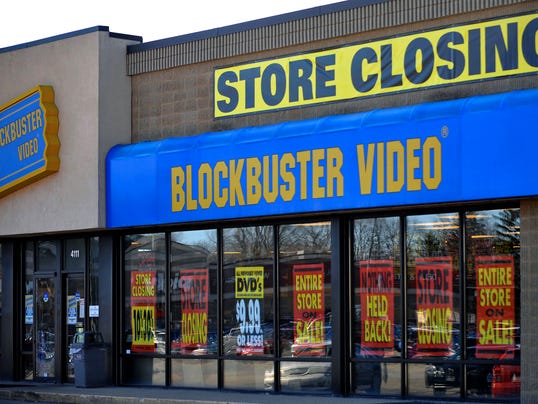
Blockbuster is shutting its doors.

Blockbuster the once popular video rental chain is putting the last nail in their coffin. The company has seen a steady decline in business over the last 5 years and has not been able to compete with other video services such as RedBox or Netflix. Blockbuster's mail services and streaming services simply were not able to compete.

Blockbuster shuts down
Blockbuster announced that they will be stopping all retail and mail order services next January. Blockbuster was bough by Dick networks in 2010 after going bankrupt. This purchase included roughly 300 locations both domestic and internationally. This shutdown will result in the termination of around 3000 jobs.

The Blockbuster streaming services will continue moving forward. Dish says the Blockbuster franchise will stay open and that they will retain all licensing agreements with Blockbuster. For Dish users this included 15 movie channels with thousands of movies.

With old relics like Blockbuster finally disappearing it makes me wonder what will happen the the video world next. How will we see Netflix and Amazon grow in the next 10 years.